
Complete Retirement Planning Guide
Retire With Confidence, Federal Employees
Master your TSP, optimize your pension, and retire with confidence — starting today.
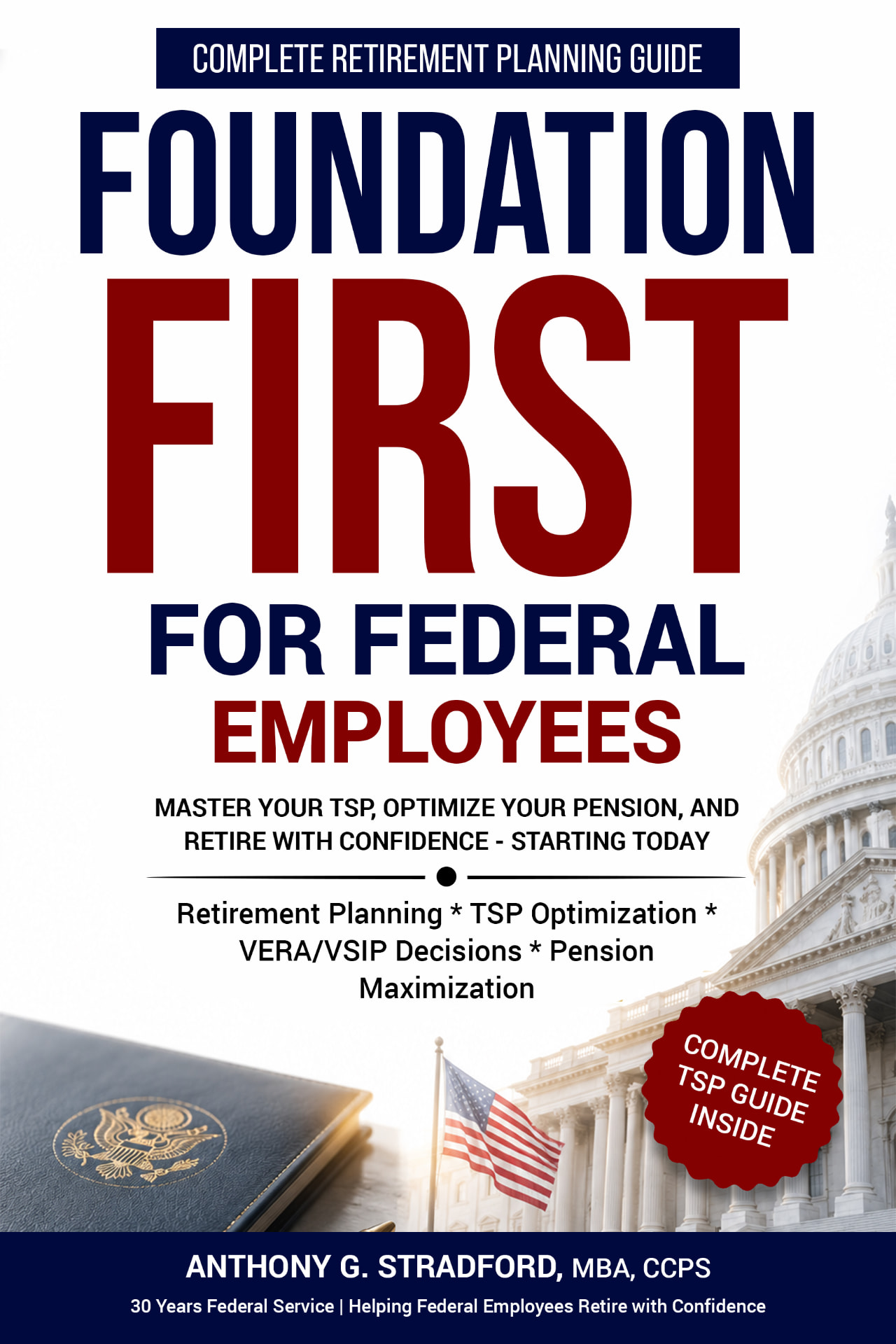
Your practical, step-by-step guide from Foundation First
Master your TSP
Maximize your pension
Make smart VERA/VSIP decisions
Your federal retirement, decoded.
An educational guide that helps you understand the concepts before you talk with qualified professionals. Not legal, tax, investment or benefits advice.
The retirement planning model
Three Legged Stool
Will All Three Legs of Your Federal Retirement Plan Hold Up?

Three legs.
One retirement.
Leg 1, left: FERS Pension
Defined formula — high-3 × years × 1% (1.1% at 62+ with 20+ yrs)
Green: a defined pension you can calculate. Yellow: 1% per year is modest salary replacement, and the gross figure shrinks to net after taxes, survivor elections and health premiums.
Leg 2, middle: TSP
Caution — longevity, withdrawal & market risk
How long could your TSP last through market ups and downs and the withdrawals you plan to take?
Leg 3, right: Social Security1
2026 Trustees financing warning
When should you claim, and how could the program's projected financing gap affect your plan?
How the FERS basic pension is calculated
For most regular FERS employees, the annual gross basic annuity is: high-3 average basic pay × creditable years of service × 1%.
The multiplier rises to 1.1% only if you retire at age 62 or older with at least 20 years of service — it does not apply automatically, and not all federal workers qualify. Eligible special-provisions employees (such as federal law enforcement officers, firefighters and air traffic controllers) use a different, higher formula shown below — it is separate from the 1.1% multiplier, not combined with it. Early-retirement or other reductions can also apply.
Standard — 1%
Most regular FERS employees
$100,000 high-3 × 30 years × 1% = $30,000/year (about $2,500/month)
Enhanced — 1.1%
Retiring at age 62+ with 20+ years of service
$100,000 high-3 × 30 years × 1.1% = $33,000/year (about $2,750/month)
Special provisions — 1.7% + 1%
Eligible law enforcement, firefighters, air traffic controllers: 1.7% × high-3 × first 20 qualifying years, then 1% × high-3 × additional years
$100,000 high-3 × 25 qualifying years: (20 × 1.7%) + (5 × 1%) = 39% = $39,000/year (about $3,250/month)
Eligibility caveat: qualifying service, retirement provisions and exceptions determine whether the 1.1% or special-provisions formulas apply — holding one of those job titles does not by itself guarantee eligibility. The three multipliers are alternatives, not add-ons: special-provisions employees do not also receive the 1.1% rate.
Hypothetical illustration with a round $100,000 high-3, chosen for clarity — not your estimate. Both figures are gross, before federal and state taxes, survivor benefit reductions, health premiums and any other applicable deductions, so spendable income will be lower. Educational information only; not legal, tax or financial advice.
What the 2026 Trustees Report projects1
2032
Year the Old-Age and Survivors Insurance (OASI) trust fund reserves are projected to be depleted.
78%
Share of scheduled retirement benefits that ongoing income is projected to pay after that point, absent legislation.
1 Source: Social Security Administration, “A Summary of the 2026 Annual Reports,” Social Security and Medicare Boards of Trustees, 2026: https://www.ssa.gov/oact/trsum/. These are Trustees' projections under intermediate assumptions, not guarantees, and they can change each year. The projected shortfall is a financing gap — it is not an enacted benefit cut, and Congress can change the outcome through legislation. Benefits are not projected to disappear. Educational information only; not legal, tax or financial advice.
Look inside the Federal Edition
What You'll Find Inside
Your pension. Your savings. Your benefits. A clearer view of how they can work together — and where to ask better questions.
Educational benefit previews, not a chapter list or quoted book excerpts. Your eligibility and circumstances determine which provisions apply.
Understand your FERS pension
Make sense of high-3 pay, creditable service and the standard 1% formula. Understand when the 1.1% rate may apply — age 62 or older with at least 20 years — and how eligible special provisions use 1.7% for the first 20 qualifying years, then 1% for additional years. Eligibility and exceptions matter; these are not combined rates.
Look beyond your TSP balance
A savings balance is not a lifetime income promise. Explore how withdrawals, market volatility and the length of retirement can affect how long your TSP may support you.
Put Social Security in perspective
Consider Social Security's role alongside your pension and savings, how claiming timing affects benefits, and why financing projections deserve attention without assuming benefits will disappear.
Bring the three income sources together
See FERS, TSP and Social Security as connected parts of your retirement income picture. Different starting dates and income patterns matter — as do taxes and applicable deductions when moving from gross income to spendable income.
Recognize potential income gaps
Compare estimated retirement income with the spending you expect. Consider where healthcare costs, inflation, withdrawals or changing circumstances could leave a gap worth discussing with qualified professionals.
Take action while you have time
Build a clearer understanding of your choices before retirement arrives. Review your benefit estimates, think through your timeline and bring better-informed questions to your agency benefits office and qualified advisers.
See the bigger retirement picture.
Start with the Federal Edition. Educational guidance, not a personalized benefits determination or a guarantee of retirement income.
$0 book + shipping & handling · $12.95 shipping & handling

Meet the author
Anthony G. Stradford, MBA
Financial educator · CFP® course instructor · Retired U.S. Marine Corps Master Sergeant · 30 years of federal service · VA-Accredited Veterans Service Officer · 2026 Men to Watch Award honoree.
Claim Your Complimentary Copy Today
The book is free — you pay only shipping & handling. Enter your shipping details below and check out securely with Stripe.
Your book
$0
+ $12.95 shipping & handling — your only charge
Total due at checkout: $12.95 (US addresses only). Secure payment by Stripe.
Complimentary 30-Minute Retirement Readiness Consultation
Your Financial Future Deserves a Plan.
No cost • No obligation • No book purchase required
Get Your Numbers. See the Road Ahead.
A separate, optional, no-obligation introductory conversation — you don't need it to get the book.
- Walk through your retirement timeline
- Review benefit estimates using information you choose to share
- See illustrative savings-depletion scenarios
- Spot potential gaps worth a closer look
Educational and introductory only. It is not a comprehensive financial plan, no results are guaranteed, and there is no obligation to buy anything. Never share your Social Security number or account numbers — we won't ask for them.